SaaS lead generation is how a software company finds people who could buy and turns them into booked demos or trials. Pick your channels by deal size and by how your buyers look for software. Then judge every channel by what a qualified demo costs you. This guide covers the channels, the prices, the math from lead to closed deal, and what to do once a lead comes in.
What is SaaS lead generation?
SaaS lead generation is the work of getting the right people to raise their hand, and of finding out which of them can buy. Those are two separate jobs.
A lead is anyone who gave you a way to contact them. A qualified lead matches the customer you sell to: the right company, the right role, a need you solve and the budget for it. One hundred leads with five qualified buyers are worth less than twenty leads with ten.
SaaS has three habits of its own:
- Buyers research alone. They read, compare and ask peers before they talk to you, so your page and your proof have to do part of the selling.
- Several people decide. The person who books the demo often needs a manager, finance or IT to agree.
- Revenue repeats. A customer pays every month or year, so a lead who stays is worth far more than one who signs and leaves.
How does the SaaS lead generation funnel work?
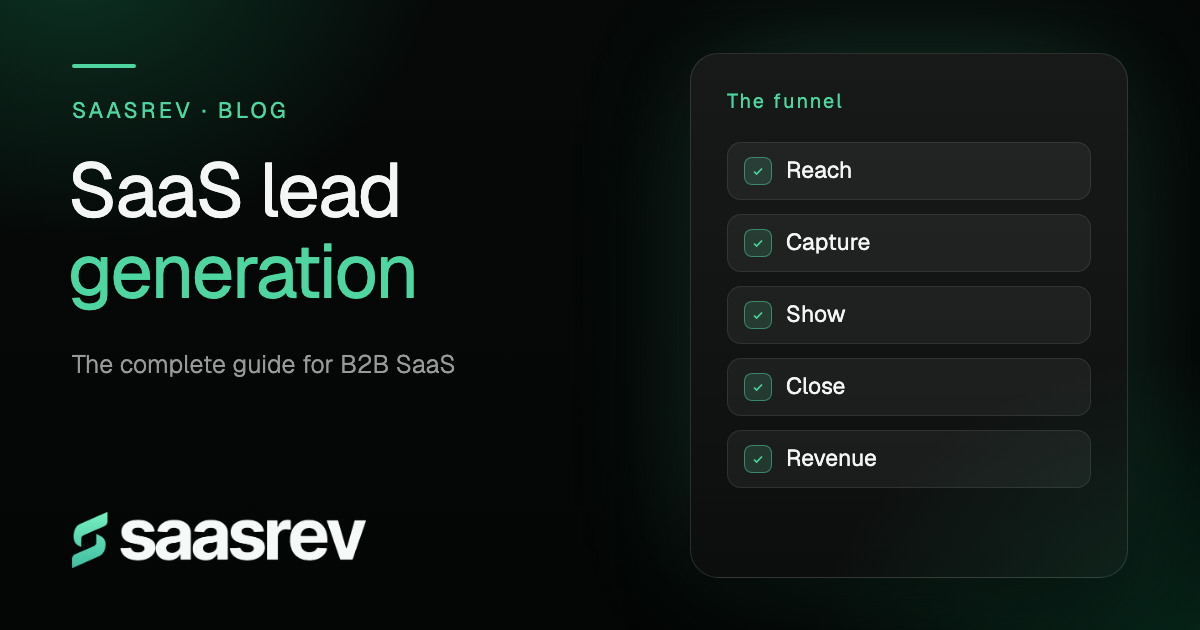
The funnel has five steps, and each one has a single number to watch. When results drop, find the step whose number moved and fix that one first.
| Step | What happens | Number to watch |
|---|---|---|
| 1. Reach | The right buyers see your ad, post, email or page | Cost per visit from right-fit accounts |
| 2. Capture | They fill a form, start a trial or book a call | Visitor-to-lead rate |
| 3. Show | The people who booked turn up | Show rate |
| 4. Close | The demo becomes a customer | Close rate on held demos |
| 5. Revenue | The customer pays and stays | Customer acquisition cost (CAC) and payback time |
The steps multiply. A 50% show rate halves the return on every booking you paid for. For the fixes at each step, read how to get more demos for your B2B SaaS.
Which SaaS lead generation channels work best?
The channels that work best are the ones your buyers already use when they look for a tool like yours. Use this table to shortlist two, then test. The speeds and warnings are our judgment from running campaigns.
| Channel | Best for | How fast it works | Watch out for |
|---|---|---|---|
| Paid search | Buyers who already search for your category | Fast, within weeks | Broad keywords and clicks from job seekers or students |
| LinkedIn ads | Larger contracts and named roles or companies | Medium, longer with a long sales cycle | High click prices on a small budget |
| Paid social (Meta) | Large groups of similar buyers | Fast to test | Cheap leads who do not fit unless you qualify them |
| Intent data | Reaching accounts already researching your category | Medium | Treating a signal as proof that they will buy |
| Outbound | A short list of valuable accounts | Medium, after email setup | Poor lists and spam complaints |
| SEO | Questions buyers ask before they choose | Slow, months | Traffic from readers who never buy |
| Partners | Products that plug into a tool buyers already use | Slow to start, steady later | Partners with no reason to mention you |
| Communities | Niches where buyers talk to each other | Slow | Selling before you have helped anyone |
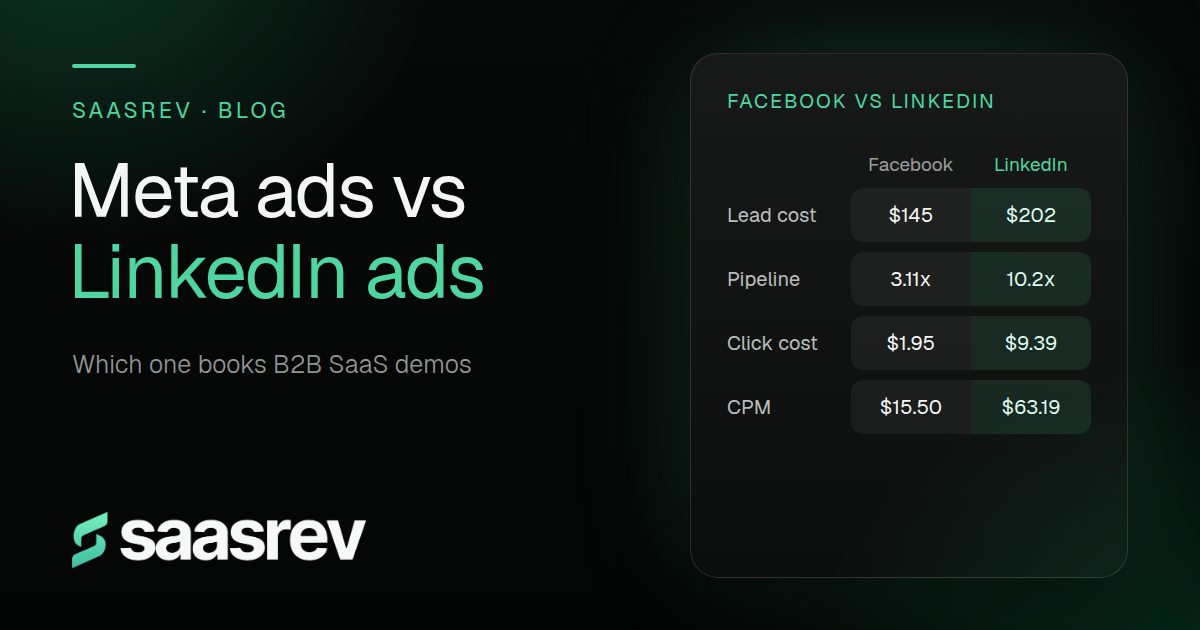
Three of these deserve a closer look before you spend. We compare paid ads and outbound side by side, and Meta ads and LinkedIn ads on cost per qualified demo. If you plan to buy signals, start with how B2B intent data works.
How much does a SaaS lead cost?
A B2B SaaS lead costs $249 on average, according to First Page Sage's cost per lead report, updated October 8, 2026. The same report gives $318 for paid channels and $186 for organic ones. It uses data collected between January 2022 and August 2026.
Use those figures to check whether your own are in a sensible range. Don't use them to choose a channel, because cost per lead says nothing about who the lead is. Cost per qualified demo does: total spend divided by the qualified demos that took place.
This example uses made-up numbers. They are not a client result.
| Channel A | Channel B | |
|---|---|---|
| Spend | $10,000 | $10,000 |
| Cost per lead | $100 | $250 |
| Leads | 100 | 40 |
| Qualified leads | 10 | 20 |
| Qualified demos held | 5 | 10 |
| Cost per qualified demo | $2,000 | $1,000 |
Channel A looks 60% cheaper on leads, and its qualified demos cost twice as much. If your costs are climbing, read how to lower SaaS CAC before you cut the budget.
Which channel should you choose for your deal size?
Choose by how much one customer pays you in a year, because that sets how much you can spend to win one. These bands are our rule of thumb.
Under $5K a year. Use channels that need no salesperson for each account: SEO, communities, partners, and paid social or search that leads to a trial. A 30-minute demo for every prospect is hard to pay for at this price, so let the product do the showing.
$5K to $50K a year. Use paid search and paid social with a qualifying funnel in front of a demo. Add intent data once you know which accounts close. Above roughly $25K, outbound starts to pay as well, because the deal covers the time spent on one account.
Over $50K a year. Use LinkedIn ads to named companies, outbound, partners and intent data together, aimed at the same list. Expect a higher cost per lead and more people in each decision. Choros AI paid $180 to $220 for an enterprise lead against $40 to $60 for a self-serve one, and its enterprise contracts run from $50K to $150K or more a year. The Choros AI case study has the details.
How many leads do you need?
Work backwards from your revenue goal: first the deals, then the demos, then the leads and visitors. Here is the math for a goal of $600,000 in new annual recurring revenue. The goal and the rates are made up, except the 62% booking rate, which is the RevenueHero median described in the next section.
| Step | Math | Result |
|---|---|---|
| Deals | $600,000 / $24,000 average contract | 25 a year |
| Demos held | 25 / 25% close rate | 100 a year |
| Demos booked | 100 / 75% show rate | about 133 a year, 11 a month |
| Qualified leads | 133 / 62% booking rate | about 215 a year, 18 a month |
| All leads | 215 / 50% qualified | about 430 a year, 36 a month |
| Visitors | 430 / 3% visitor-to-lead rate | about 14,300 a year, 1,200 a month |
Put your own goal, contract value and rates into the demo calculator. Change one rate at a time and you will see which fix saves the largest number of visitors.
How do you qualify SaaS leads?
Qualify SaaS leads before the call, with a short video and a few questions that decide who can book. A salesperson's hour is too expensive to spend finding out that a company has the wrong size or no budget.
Ask only what changes your answer. Company size, role, the tool they use today, and when they need a change are usually enough. Send poor fits to a trial, a newsletter or a lighter product, and show the calendar to the rest. A video sales letter (VSL) placed before the calendar answers the common questions, so the people who book already know what you do. We explain the setup in what a VSL funnel is.
Then watch how many qualified leads book. RevenueHero, which sells scheduling software, reports a median of 62% across its customers in a post dated September 10, 2026, based on over one million B2B SaaS form submissions. A second RevenueHero post, dated April 13, 2026, says the numbers come from companies using instant scheduling, so a team that books by email should expect less.
What happens after the lead comes in?
After the lead comes in, speed and proof decide whether the demo takes place. Do four things:
- Follow up within minutes. Call or text while the person still has your page open.
- Keep the wait short. Offer times today, tomorrow or the day after.
- Send proof before the call. A case study from a similar company and a short answer to the usual objection work well.
- Track the lead to revenue. Connect the CRM to the campaign, so you know which ad produced the customer.
Reminders by email and text protect the show rate. The full sequence is in how to reduce demo no-shows.
What does it look like in practice?
In practice, the gains come from a narrower buyer, a stricter qualifying step and faster follow-up. These are published SaaSRev client results.
| Client | What changed | Before | After |
|---|---|---|---|
| Acrely | One customer profile in place of five | CAC over $25,000 | CAC of $4,283 and $1.155M in new ARR in 90 days |
| VitalityPlus | Two funnels and a call within 60 seconds | 2 to 3 calls a week, 35% show rate | 150+ demos a month, 68% show rate |
| Instapatient | Outbound and paid ads aimed at one buyer | About 2 demos a week | Over 100 qualified demos a month |
| Choros AI | Separate self-serve and enterprise funnels | Enterprise close rate about 20% | Enterprise close rate 52% |
VitalityPlus sells a done-for-you press service, and the other three sell software. These results come from specific engagements and are not a guarantee. See our Terms of Use.
What are the most common mistakes?
The most common mistakes come from counting leads and losing sight of who they are:
- Choosing a channel by cost per lead and never checking how many leads were qualified.
- Selling to several kinds of customer with one message.
- Letting anyone book a call, then blaming the sales team for the close rate.
- Waiting hours or days to contact a new lead.
- Running five channels on a budget that can only test one.
- Stopping a test before one full sales cycle has passed.
Should you hire a SaaS lead generation agency?
Hire a SaaS lead generation agency when you have paying customers, a clear buyer and an ad budget, and nobody in-house has time to run the whole path from ad to call. SaaSRev fits B2B SaaS teams that can put $3K to $5K a month into ads and want 3 to 5 pre-qualified demos a week.
Hold off if you have no revenue yet, if you are still looking for product-market fit, or if nobody can take the calls. An agency can't fix those for you.
Before you sign with anyone, ask:
- Do you report cost per qualified demo, or only leads?
- Who owns the ad accounts, the landing pages and the data if we stop?
- Who follows up with a new lead, and how fast?
- Which client most like us can we read about or talk to?
- What will you do in the first 30 days?
If you want a second opinion on your channels and your numbers, book a strategy call. We will look at where your leads drop off and tell you which step we would fix first.
Frequently asked questions
What is SaaS lead generation?
SaaS lead generation is how a software company finds people who could buy its product and turns them into booked demos or trials. It covers the channels that bring people in, the page or form that captures them, and the qualifying step that decides who gets a call.
How much does a SaaS lead cost?
First Page Sage's cost per lead report, updated October 8, 2026, puts the B2B SaaS average at $249 blended, $318 from paid channels and $186 from organic ones. Your own number depends on channel, deal size and how strictly you define a lead.
What is the best lead generation channel for B2B SaaS?
The best channel is the one with the lowest cost per qualified demo held at your deal size. Paid search suits buyers who already search for your category, paid social suits a large audience of similar buyers, and outbound or account-based ads suit large contracts with a short list of target accounts.
Should a SaaS company use inbound or outbound?
Start with the one that matches your deal size, then add the other once the first books qualified demos. Larger contracts can pay for researching and writing to one account at a time. Smaller contracts need inbound, because working each account by hand costs more than the deal returns.
What is a good lead-to-demo rate?
Measure it on qualified leads. RevenueHero, which sells scheduling software, reported in 2026 that a median of 62% of qualified leads book a meeting across its B2B SaaS customers, and that the top 25% book 76% or more. If you count every lead, including poor fits, expect a much lower rate.
Should I hire a SaaS lead generation agency?
Hire one when you have paying customers, a clear buyer, room in the budget for ads, and nobody in-house with time to run the ads, the funnel and the follow-up. Wait if you have no revenue yet or still change who the product is for every month.