LinkedIn ads book more qualified demos per dollar when you can name the accounts and the buying role. Meta ads book more of them when the market is wide and questions screen buyers before they can book. For Meta ads vs LinkedIn ads for B2B SaaS, the comparison to use is cost per qualified demo held.
Meta ads vs LinkedIn ads for B2B SaaS is the choice between Facebook and Instagram campaigns and LinkedIn campaigns, scored on cost per qualified demo held. A qualified demo held means the person who fits your offer showed up for the call.
Outside figures were read on 2026-11-20, and each one links to its page. SaaSRev has worked with 100+ SaaS companies and runs Meta ads for clients, so weigh that when you read our view of Meta.
For how both fit with outbound, SEO and intent data, see our guide to SaaS lead generation.
Meta ads vs LinkedIn ads for B2B SaaS: which should you run?
Run LinkedIn when you can name the companies and the buying role, and one qualified demo can carry a high cost per lead. Run Meta when the market is wide and a qualifying video plus a few questions sit in front of the calendar. If the decision is paid ads or outbound instead, that comparison is in paid ads vs outbound for B2B SaaS.
Why are LinkedIn ads so expensive?
LinkedIn ads cost more per click because you pay for the professional filters on LinkedIn's advertising page: job title, company, industry, seniority and skills.
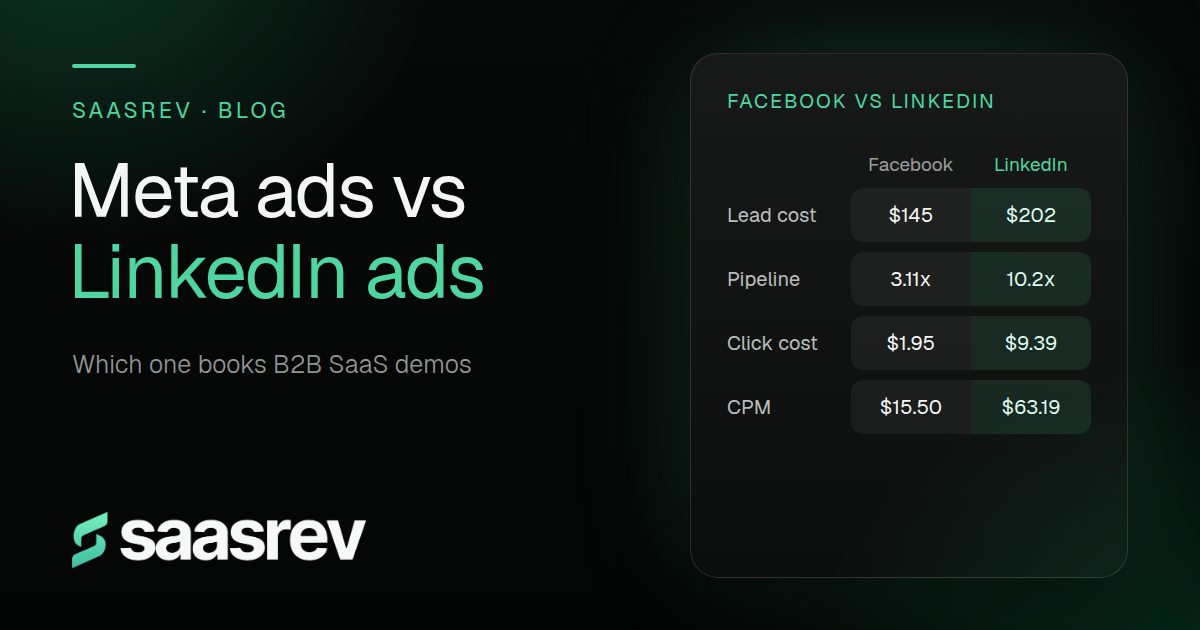
Metadata sells B2B ad software. Its 2026 B2B advertising benchmarks, read on 2026-11-20, report 2025 figures weighted by spend across 153 B2B advertisers and $57.6M. A LinkedIn click cost $9.39, from 138 advertisers, against $1.95 on Facebook, from 71 advertisers. That is about 4.8 times ($9.39 divided by $1.95). Cost per thousand impressions, the CPM, was $63.19 on LinkedIn and $15.50 on Facebook, about 4.1 times ($63.19 divided by $15.50). Instagram, the other Meta placement, was $2.82 a click and $18.25 CPM, from 49 advertisers.
LinkedIn is worth the higher cost per click when pipeline per dollar covers it. Comparing the two on cost per click or cost per lead leaves out what happens after the form, so add cost per qualified demo held.
Can you target job titles on Meta?
You can target job titles on LinkedIn, and the Meta help pages read on 2026-11-20 do not name job title, so the Meta path in this post is a customer list, a lookalike and the Conversions API.
LinkedIn's advertising page, read on 2026-11-20, says you can target by job title, industry, skills and more. The company list help said it was last updated 8 months before this read. A list can hold up to 300,000 companies or 20 MB. It needs at least 300 rows, and it must match at least 300 member accounts before an active ad set can use it. LinkedIn recommends 1,000 companies or more. You can narrow the list by job function or seniority.
On Meta, a customer list custom audience is built from identifiers you already have, such as email, phone number and address. Meta hashes them and matches them to profiles on Facebook, Instagram and the Meta Audience Network. A lookalike audience reaches new people who share characteristics with that source. A smaller percentage stays closer to the source. A larger percentage gets broader. Meta's detailed targeting page describes "interests, behaviours and demographics." Its examples are a music interest, frequent travel and being in university. Job title does not appear there, so this post does not plan Meta spend around a job title field. The LinkedIn ad account can filter by role and company list. On Meta, the ad and the questions before the calendar do that screening.
Which channel gets the cheaper lead, and which gets more pipeline?
Instagram and Facebook produce the cheaper leads in Metadata's 2025 dataset, at $138 and $145, and LinkedIn produces more pipeline per dollar, at 10.2x against Instagram's 1.8x and Facebook's 3.11x.
Those figures are on Metadata's LinkedIn pipeline insight, read on 2026-11-20, from the benchmark report set of 153 advertisers and $57.6M of 2025 spend. Pipeline is the value of opportunities the CRM credits to an ad-generated lead, for the 90 advertisers with a CRM connected. The insight page also writes the LinkedIn return as $10.20 of pipeline per $1 of lead generation spend. Google Ads, in the same study, is $524 a lead and 3.95x pipeline.
| Channel | Cost per lead | Pipeline per $1 | Cost per click | Per 1,000 impressions |
|---|---|---|---|---|
| $202 | 10.2x | $9.39 | $63.19 | |
| $145 | 3.11x | $1.95 | $15.50 | |
| $138 | 1.8x | $2.82 | $18.25 |
Click price and CPM in that table are from the benchmarks page, which weights its figures by spend and prints the same cost per lead. On that page, 5.9% of LinkedIn clicks became leads, against 2.6% on Facebook and 4.0% on Instagram.
Metadata reports Facebook and Instagram separately and publishes no blended Meta figure.
Dreamdata sells B2B attribution software, and its press release of 10 March 2026 calls Dreamdata a LinkedIn Marketing Partner. The release says return on ad spend uses Dreamdata's attribution model on closed won deals over 12 months, and that impressions are left out. Its announcement, also dated 10 March 2026, puts 2025 return on ad spend at 121% for LinkedIn, 67% for Google Search and 51% for Meta. In Dreamdata's data Meta has the cheaper click (€1.60 against €5.98 on LinkedIn) but costs more per company influenced (€128.70 against €70.11 on LinkedIn). Google Search is €110.37 per company influenced. Dreamdata reports Meta as one line.
What does a cheap lead cost once the demo is held?
In this example an open Meta calendar costs $1,600 per qualified demo held, and the same spend with questions before the calendar costs $1,000, tying LinkedIn. This example uses made-up numbers. They are not a client result, and they are separate from Metadata's 2025 benchmarks.
Each column spends $8,000. In the example Meta's 80 leads cost $100 each and a quarter of them fit. LinkedIn's 32 leads cost $250 each and half of them fit. On the open calendar, 40 leads book, fit and unfit at the same rate, and half of every booking shows up. With questions first, only fit leads can book: 10 book, and the show rate is 80%. That 80% is an assumption of the example, for buyers who watched a short video and knew why they booked. LinkedIn uses the same 10 bookings and the same 80% show rate.
| Meta, open calendar | Meta, questions first | ||
|---|---|---|---|
| Spend | $8,000 | $8,000 | $8,000 |
| Leads | 80 | 80 | 32 |
| Qualified rate | 25% | 25% | 50% |
| Booked | 40 | 10 | 10 |
| Show rate | 50% | 80% | 80% |
| Demos held | 20 | 8 | 8 |
| Qualified demos held | 5 | 8 | 8 |
| Cost per demo held | $400 | $1,000 | $1,000 |
| Cost per qualified demo held | $1,600 | $1,000 | $1,000 |
A cheap lead wins on cost per qualified demo held when the funnel screens people before they book.
What budget do you need for LinkedIn ads?
LinkedIn's budget page, read on 2026-11-20, says the minimum daily budget to start is $10 for any ad format, and the minimum lifetime budget for a new, inactive campaign is $100. After launch, the lifetime floor becomes $10 times the days on the schedule. For advertisers paying in US dollars, Campaign Manager suggests $25 a day for a new advertiser and $50 to $100 a day for an existing one. Those amounts are suggestions. The page also says a campaign budget can cap the ad set budgets inside the campaign.
Set a month at the $10 floor next to Metadata's $202 LinkedIn lead and you get $300, about 1.5 leads. One or two leads cannot show a qualified rate or a show rate. Open the account at the minimum if you need to. Judge the channel on a budget that can produce several qualified demos.
Should you run Meta ads and LinkedIn ads together?
Run both once one channel is booking qualified demos you can trace to pipeline. Split the money by contract size and by whether you can name the accounts.
Put more on LinkedIn when one customer carries a large annual contract and you can upload a company list LinkedIn will run: at least 300 matched member accounts, with 1,000 companies the size LinkedIn recommends. A $202 lead is easier to carry when that contract is large. Put more on Meta when many similar buyers exist and the video plus the questions can refuse a poor fit before the calendar.
The same Metadata benchmarks page, in its 2025 lead generation cut, prices Facebook retargeting leads at $120 and Facebook prospecting leads at $166. LinkedIn retargeting leads are $234 and LinkedIn prospecting leads are $194. In that cut, retargeting is the cheaper Facebook lead and the higher LinkedIn lead. Check that split against your own pipeline before you copy it.
How do you stop Meta leads from being junk?
Stop Meta leads from being junk by keeping the calendar closed until the person has watched a short video and answered a few questions. Junk means a lead who does not fit, or who books and never attends.
- The ad names one buyer and one offer. The video says the same thing, in words from your sales calls.
- The visitor answers company size, role and timing. The calendar opens after the answers. That order is a VSL funnel for SaaS.
- The confirmation says what the call will cover, the wait stays short, and reminders go only to people who agreed to them. Those steps are how you reduce demo no-shows, and show rate is part of the cost per qualified demo held.
- Send the qualified demo held stage from the CRM to Meta through the Conversions API. Meta's page, read on 2026-11-20, says the API accepts events from a CRM and from offline activity, and that those events feed optimization and measurement. An account that only receives form fills will look for more form fills.
On LinkedIn, Metadata's benchmarks page says a lead form produced a lead for $193 in 2025 lead generation campaigns, and sending that click to a landing page cost $346. The form is ahead on cost per lead. The form or the page still has to ask the qualifying questions, or the cheaper lead reaches the calendar anyway.
SaaSRev is paid acquisition for B2B SaaS: ads, a qualifying VSL funnel, and follow-up that books qualified demos. For product-led SaaS, the services pages aim at free trials, signups and self-serve conversions. For sales-led SaaS, the aim is booked demos. If you already chose Meta and you are choosing who runs it, six options are compared in best Meta ads agency for B2B SaaS.
To apply the split to your contract size and your show rate, book a strategy call.
Frequently asked questions
How long should you test Meta ads against LinkedIn ads?
Run the test at least as long as your sales cycle, so qualified demos have time to reach pipeline. Dreamdata, which sells B2B attribution software, said in its 10 March 2026 press release that the buyer journey in its report grew from 211 days to 272 days. A week of spend can show cost per lead. Read both channels on the same dates, on qualified demos held and on pipeline.
What counts as a qualified demo held?
A qualified demo held is a booked call that a buyer who fits your offer actually attends. Fit is the role, the company and the timing your sales team already accepts. A form fill is a lead. A booking that nobody attends is a missed call. Compare Meta and LinkedIn on attended calls with a fit buyer.
Should product-led SaaS send Meta ads to a demo?
Send product-led buyers to the trial or the signup when they can see the product without a call. SaaSRev's services pages say product-led work is aimed at free trials, signups and self-serve conversions. Use a demo calendar when someone has to talk to sales before buying, and keep qualifying questions in front of that calendar.
Should the same ad run on Meta and LinkedIn?
Use the same offer and the same buyer, and cut the ad for the channel. LinkedIn can name the role in the targeting, so the ad can speak to that role. The Meta help pages read on 2026-11-20 do not name job title targeting, so the Meta ad has to say who it is for, and the questions finish the screen.