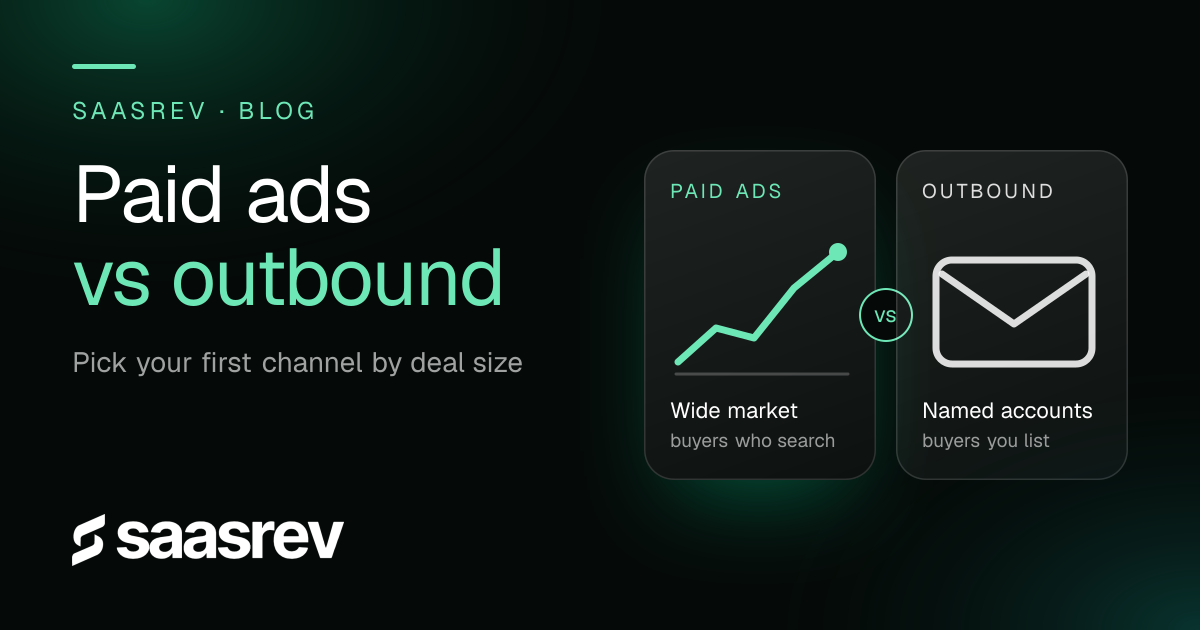
Start with outbound if your deals are large and you can write down your target accounts by name. Start with paid ads if your deals are smaller, your market is wide, or buyers already search for what you sell. That is the short answer to paid ads vs outbound for B2B SaaS, and the rest of this post is the reasoning behind it. We sell paid ads work, so check our logic against your own numbers. In several cases below, outbound is the better first move.
Paid ads vs outbound for B2B SaaS: which should you start with?
Start with the channel that matches your deal size and your market. Find the rows that describe you.
| Your situation | Lean toward | Why |
|---|---|---|
| Annual contract value above roughly $25K | Outbound | A deal this size pays for researching and writing to one account at a time |
| Annual contract value below roughly $10K | Paid ads | Hand-working each account costs more than the deal returns |
| You can list every target account, and there are a few thousand at most | Outbound | You can reach each one directly, so you do not need to pay for reach |
| Your market is wide and fragmented | Paid ads | Ads reach buyers you could never put on a list |
| Buyers already search for or compare tools like yours | Paid ads | The demand exists, and ads meet it where it is |
| Buyers do not yet know the problem has a name | Outbound, or ads built around a video that explains the problem | Someone has to explain it first |
| Nobody on the team can work replies every day | Paid ads | Outbound stalls without daily attention |
The dollar lines are rules of thumb that circulate among B2B SaaS teams, not the result of a study. Use them to get oriented, then test with your own numbers.
If your row says outbound but your list is only a few hundred accounts, be careful. A short list runs out fast, and every message to a company that ignores you makes the next one harder to land.
How does the cost compare?
Both channels end at the same two numbers: cost per held, qualified demo, and then CAC. A channel that looks cheaper per lead can cost more per customer, so compare them at the demo and the deal, not at the click or the email.
With paid ads you pay the platform for each click, plus the creative, the funnel and the tracking. Cost per demo rises when more advertisers chase the same buyers, and spend scales as fast as you raise the budget. With outbound you pay for data, sending domains and tools, plus the time of whoever writes, sends and answers. That cost rises with headcount, and the ceiling is the size of your list.
Speed of feedback differs too. Ads start producing data within days of going live. Outbound usually needs a few weeks of domain warm-up before you can send at volume, so your first reliable numbers arrive later. If you need to learn quickly whether your offer works, that gap matters.
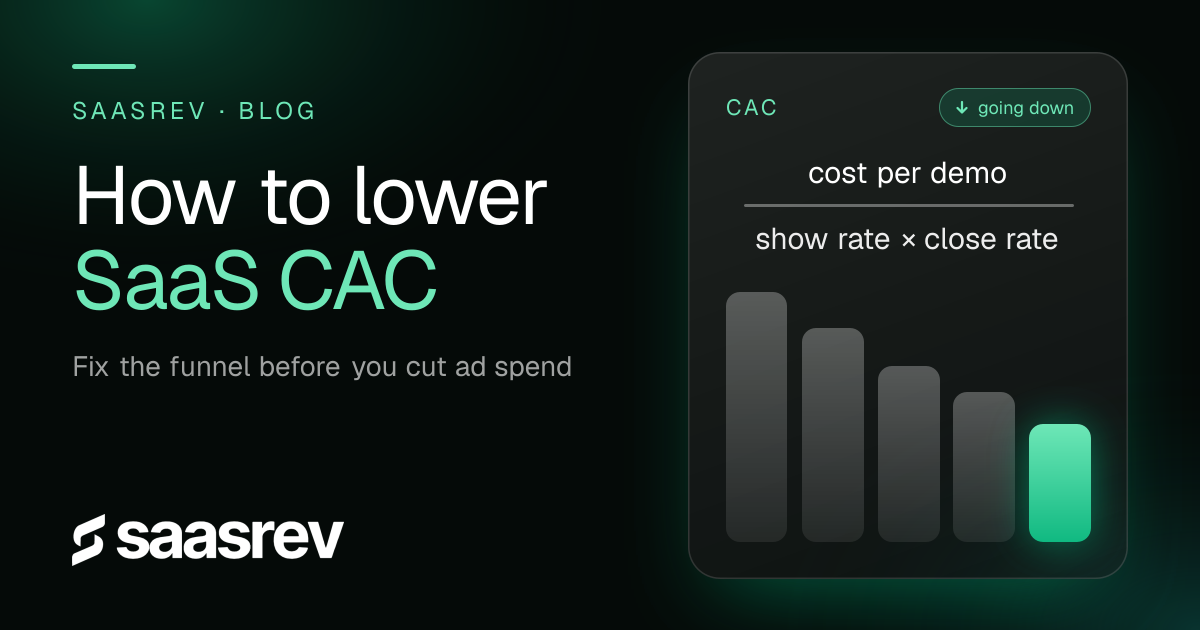
For the full math, see how to lower SaaS CAC when paid ads get expensive. To see what extra demos are worth, try the ARR calculator.
What can go wrong with paid ads?
Four problems come up most often.
- The same ad runs for weeks, the people in your target group see it again and again, and cost per demo creeps up.
- The targeting is too broad, so you pay for clicks from people who will never buy.
- Bookings come in, but too many are poor fits, so the calls are wasted.
- Tracking stops at the lead, so you cannot tell which campaign produced a customer.
Each has a direct fix, and we cover them in the CAC post above and in how to get more demos for your B2B SaaS.
What can go wrong with outbound?
The biggest risk is email deliverability. Google's email sender guidelines tell bulk senders (those sending more than 5,000 messages a day to Gmail addresses) to authenticate their mail, offer one-click unsubscribe and keep the spam complaint rate below 0.3%, with 0.1% as the safer target. Mail that people did not ask for is the kind that draws complaints, so the margin for error is thin. Many teams send from separate domains so that a reputation problem does not reach their main company domain.
The other problems are ordinary ones. A list full of outdated contacts wastes sends. A message that could have been written to anyone gets no reply. A reply that waits two days for an answer goes cold.
What does an ads-first setup look like at SaaSRev?
We start with a 14-day audit of your sales calls, messaging and ideal customer profile, before any ads run. Then we target accounts that are already researching tools like yours, test new creative every 3 to 5 days, cut what lags and put the budget behind what wins. A short video and a few qualifying questions sit in front of the calendar, so the calls you hold are with people who fit. Every demo is tracked back to the campaign behind it.
You can read about each part: intent data ads, VSL funnels and our SaaS PPC service.
This fits B2B SaaS teams that already have paying customers, can put $3K to $5K a month into ads and want 3 to 5 pre-qualified demos a week. It does not fit a company with no revenue yet, or one still searching for product-market fit.
When should you run both?
Run both once one channel books qualified demos and you can see revenue by channel. Before that, a second channel mostly adds noise.
After that, the two help each other. You can aim ads at the same accounts you email, so your name is familiar when the message arrives. The ad angle that wins can become the opening line of an email, and the email subject that gets replies can become an ad headline. Keep one booking page and one tracking setup, so the numbers from both channels can be compared on the same terms.
What does this look like in practice?
SaaSRev has published results from clients who used paid ads and funnels. Instapatient had product-market fit but only two demos a week with no predictable rhythm, and went to 100 demos a month after SaaSRev built its acquisition engine. KBS Media went from $0 to $30K MRR in 30 days. You can read more in our case studies.
Those engagements used paid ads and funnels, so they say nothing about outbound. They also come from specific companies, and they depend on each one's product, market, budget and sales process. They are not a guarantee. See our Terms of Use for details.
If you are not sure which row of the table is yours, book a strategy call and we will look at your deal size and market with you.
Frequently asked questions
Is outbound cheaper than paid ads?
Neither is cheaper by default. Outbound can cost less per meeting when deals are large and the target list is short, and paid ads can cost less when the market is wide. Compare both on cost per held, qualified demo and on CAC over the same period.
Can a small team run paid ads and outbound together?
Yes, but not on day one. One person splitting time between two new channels slows both, and you cannot tell which one is working. Get one channel booking qualified demos first, then add the other.
How long until outbound starts booking demos?
New sending domains usually need a few weeks of gradual warm-up before you send at volume, so reliable numbers arrive later than they do with ads. Test with a small, well-researched batch first and judge it by qualified demos, not by replies.
Does cold email still work for B2B SaaS?
It can, when the list is accurate, the message is relevant to the person reading it and your mail is authenticated. Google tells bulk senders to keep the spam complaint rate under 0.3% and to aim below 0.1%, so careless volume gets blocked quickly.