To lower SaaS CAC when paid ads get expensive, fix the funnel behind the ads before you change the channel. CAC is the cost of a demo divided by how many of those demos show up and how many of the ones that show up close. A better show rate or a better close rate lowers CAC as much as a cheaper click does. Below is the math, the five fixes we would try in order, and when a high CAC is fine.
What is SaaS CAC, and why does it rise when ads get expensive?
Customer acquisition cost is what you spend to win one new customer. The plain version is total sales and marketing spend in a period, divided by the new customers won in that period. Include ad spend, agency fees, tools and the salaries of the people who run the funnel and the calls, or the number will look better than it is.
When ad prices go up, you pay more for the same click, so each demo costs more. That is the part everyone sees. The part people miss is that cost per demo is only one of three numbers in the equation:
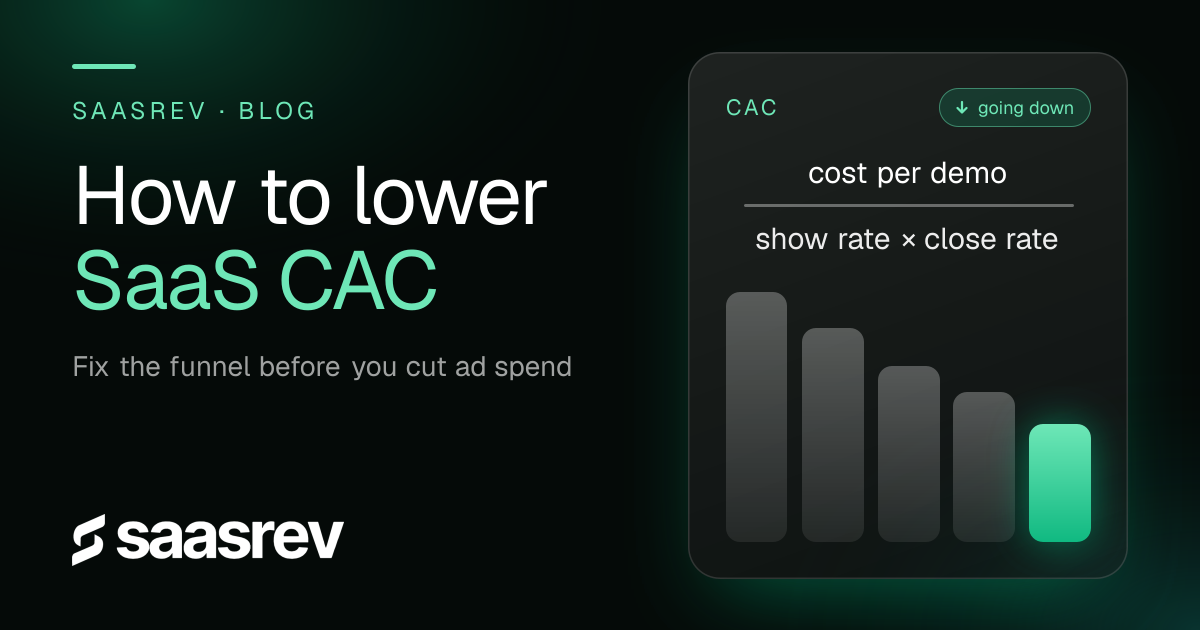
CAC = cost per demo ÷ (show rate × close rate)
Show rate and close rate are always below 100%, so each one raises the cost of every deal you win. A weak show rate or close rate can double CAC without a single click getting more expensive.
Where should you look first to lower SaaS CAC?
Look at cost per demo, show rate and close rate, and work out all three before you touch the budget. This example uses made-up numbers to show the effect. They are not a client result.
| Before | After | |
|---|---|---|
| Cost per booked demo | $400 | $400 |
| Show rate | 70% | 80% |
| Close rate on held demos | 25% | 30% |
| Cost per held demo | $571 | $500 |
| CAC (ad cost only) | about $2,286 | about $1,667 |
The cost of a click did not change in this example. CAC still fell by about 27%, because more booked people showed up and more of them were a fit. That is why we start with the funnel before we start arguing about the ad platform.
Match what you see to where the leak probably is:
| What you see | Likely leak | Start with |
|---|---|---|
| Cost per demo is climbing, the rest is steady | Targeting or creative | Fix 1 and Fix 2 |
| Plenty of bookings, many no-shows | Show rate | Fix 4 |
| Demos happen but few close | Fit and qualification | Fix 1 and Fix 3 |
| You cannot say which channel produces customers | Tracking | Fix 5 |
Fix 1: Are you paying to reach companies that cannot buy?
Aim your spend at companies that fit your ideal customer profile and are in the market now. Broad targeting is the quiet reason many ad accounts get expensive: you pay for clicks from people who were never going to book a call, let alone buy.
Tighten who sees the ads. Exclude job titles and company sizes that never close, and look at which customers actually stayed when you decide who to keep. Intent data is one way to find accounts that are researching your category right now. We target accounts already researching tools like yours, and we treat that as a signal to test against plain targeting, not a promise. See how intent data ads work.
Fix 2: Is your creative stale?
When the same ad runs for weeks, the people in your target group see it again and again, and fewer of them respond. Your cost per demo can climb with no change to the market at all.
Give creative a schedule. We test new angles every 3 to 5 days, cut what lags and put the budget behind what wins. Change one thing at a time, so you know which change moved the number. Our SaaS PPC service is built around this loop.
Fix 3: Should you qualify buyers before the call?
Yes, if your close rate is the weak number. A short video and a few qualifying questions before the booking filter out poor fits and prepare the good ones, so the calls you hold are with people who can buy.
The trade-off is that you will see fewer raw bookings. Judge the change by cost per qualified demo and by CAC, not by the number of calendar entries. We cover the mechanics in what a VSL funnel is and in our VSL funnels for SaaS service.
Fix 4: How fast do you follow up after a booking?
As fast as you can, in minutes. A booking is warmest right after it happens, and every no-show is a demo you paid for and did not get.
Send a confirmation that says what will happen on the call, then reminders before it. Keep the gap between booking and call short, because the longer the wait, the more people drift away. If show rate is your weak number, this fix costs the least and works the fastest. For the rest of the path from click to call, read how to get more demos for your B2B SaaS.
Fix 5: Are you measuring CAC by channel, all the way to revenue?
Track every customer back to the campaign that produced the first click. If you only track leads, you will keep the campaigns that book cheap demos and cut the ones that bring the customers.
Watch cost per qualified demo, CAC by channel, and payback time, which is how many months of gross margin it takes to earn back the CAC. Then compare channels on the same terms. To see what a change in demos is worth, put your numbers into the ARR calculator.
When is a high CAC fine?
A high CAC is fine when the customer is worth it. If a customer pays you enough, for long enough, to cover the cost of winning them with room to spare, a CAC that looks scary may still be a good deal. The rule of thumb many SaaS teams quote is lifetime value of about three times CAC, paid back within about a year. Treat it as a starting point and check it against your own margins and churn.
This is also the reason not to cut a channel because its CAC went up. A channel with a higher CAC and better customers can beat a cheaper one. Compare cost per customer that stays, not cost per lead.
What does this look like in practice?
SaaSRev has published results from clients who fixed the path from ad to call. Instapatient had product-market fit but only two demos a week with no predictable rhythm, and went to 100 demos a month after SaaSRev built its acquisition engine. KBS Media went from $0 to $30K MRR in 30 days. You can read more in our case studies.
Those are demo and revenue results, not CAC figures, and they come from specific engagements. They depend on each company's product, market, budget and sales process, and they are not a guarantee. See our Terms of Use for details.
If you want help finding which of these five fixes your funnel needs first, book a strategy call.
Frequently asked questions
What is a good CAC for a B2B SaaS?
It depends on what a customer is worth to you. A commonly quoted rule of thumb is a customer lifetime value of about three times CAC, with CAC paid back from gross margin within roughly a year, but these are rough guides and not laws. A higher CAC is fine if the customer stays long enough and pays enough to cover it.
Should I cut ad spend when CAC goes up?
Not as a first move. If you cut spend before you know where the leak is, you lose the demos that still close and the CAC may not improve. First find out whether the problem is cost per demo, show rate or close rate, then fix that part. Cut only the campaigns and creative that lag.
How long does it take to lower CAC?
Changes you control directly, such as follow-up speed and the booking path, can move show rate within a few weeks. Targeting and creative tests need ad data to learn, so give them longer. Judge CAC over a period at least as long as your sales cycle, because a closed deal can lag the ad by weeks.
Does intent data lower CAC?
It can, because it points your spend at companies already researching tools like yours. Treat it as a signal and test it against plain targeting, so you know it pays for itself. If it does not lower your cost per qualified demo, drop it.