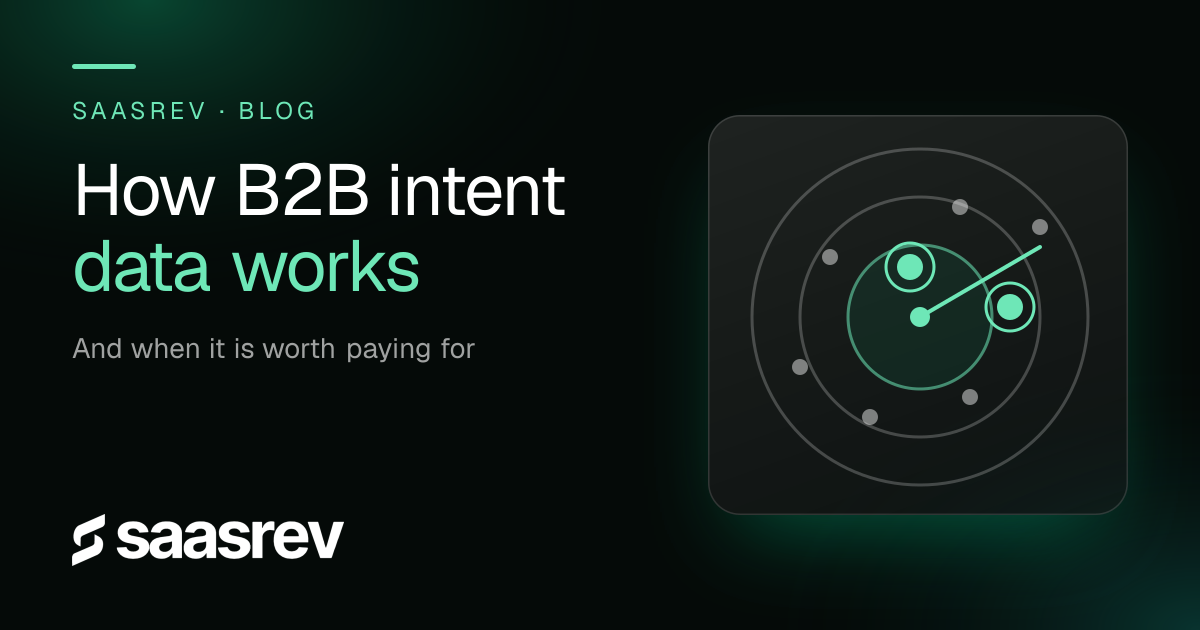
B2B intent data collects signs that a company is researching a topic, such as content reads, searches and site visits, and scores accounts by how much and how recently they show them. It can point your ad spend at buyers who are already looking. The signals are noisy, though, so the sensible move is to test it against plain targeting before you pay for it. Below is how the data works, where it is useful, where it is not and how to run that test.
What is B2B intent data?
B2B intent data is behavior that suggests a company may be researching a category or a vendor. The idea is that a buyer who is looking right now is more likely to book a demo than one who has never thought about the problem.
You can think of it at two levels. First-party intent data comes from your own channels: who visits your pricing page, opens your emails or returns to your site. Third-party intent data comes from outside: activity on other sites that suggests a company is researching topics related to what you sell.
Where does intent data come from?
Providers pull signals from a few kinds of source. Based on what vendors describe, these include:
- visits to your own site and content downloads (first-party)
- activity on publisher networks and content sites, often pooled across many members
- activity on software review sites
- search keywords tied to a topic
- engagement with ads, and attendance at webinars
Each provider has its own mix and its own way of matching activity to a company. That is why two providers can disagree about the same account, and why it is fair to ask any vendor how the signal is collected.
How do platforms turn those signals into a list?
They attach the activity to a company, then score it. The scores usually rest on how much activity there was, how closely it matches your topics, how recent it is and whether it spiked above that company's normal level. A company that suddenly reads a lot about your category this week ranks higher than one with a steady trickle over a year.
You then use the list in one of two ways: to decide which accounts your sales team contacts first, or to decide who sees your ads. For ads, the list becomes an audience, so your spend goes to companies that are already looking.
Where does intent data fall short?
The signals are noisy. A few common problems:
- The activity may come from someone who is not a decision maker, such as a student or an analyst, and still count toward the company's score.
- A company can research a topic for many reasons that have nothing to do with buying.
- Intent data tells you that a company is looking, not that it is looking for you, or that it has budget.
- Comprehensive platforms can be expensive for small or early-stage teams.
It also fits some situations better than others. It tends to work best when your category has clear search terms and a defined buying cycle. It helps less when you sell something new that people do not yet search for, because there is little activity to detect.
When is intent data worth paying for?
It is worth testing when four things are true: you know your ideal customer profile well, your category has clear terms buyers research, you have enough ad budget to run a fair comparison, and you can track demos back to the campaign that produced them.
It is less likely to pay off when your budget is small, when you cannot measure demos by campaign, or when your targeting problem is really an offer or funnel problem. In that last case, better targeting sends better people to the same weak page. If your cost per demo is the problem, check the funnel first, as we describe in how to lower SaaS CAC.
How do you test whether intent data works for you?
Run it against a control. This is the same test we use ourselves, and it takes five steps.
- Build the intent-led audience and a plain-targeting audience from the same ideal customer profile.
- Run both with the same budget, the same ads and the same landing page, for long enough to collect real data.
- Compare cost per qualified demo, not cost per click or cost per lead.
- Follow the demos through to deals, so you see which audience produced customers.
- Keep intent data only if it lowers cost per qualified demo or raises close rate enough to cover what it costs.
You can also check a provider's list against your own history. Take the accounts that became customers, see how many of them showed up as in-market before they bought, and compare that with how often the list flags accounts that never bought. If the list does not tell the two groups apart, it will not help your ads.
How do we use intent data at SaaSRev?
We treat it as a signal, not a promise. We build audiences from accounts that are already researching tools like yours, run a plain-targeting campaign next to it as a control, test new creative every 3 to 5 days, and keep only what earns its cost. See how this works on our intent data ads page.
It also helps to know where intent data sits next to other channels. If you are deciding between ads and outbound as your first channel, read paid ads vs outbound for B2B SaaS. And since a good audience still needs a good path to a call, see what to put on a B2B SaaS landing page that books demos.
What results has SaaSRev published?
SaaSRev has published results from clients who fixed the path from ad to call. Instapatient had product-market fit but only two demos a week with no predictable rhythm, and went to 100 demos a month after SaaSRev built its acquisition engine. You can read more in our case studies.
That result comes from one engagement and depends on the company's product, market, budget and sales process. It does not show what intent data alone would do, and it is not a guarantee. See our Terms of Use for details.
If you want to know whether intent data would earn its cost for you, book a strategy call.
Frequently asked questions
Is B2B intent data accurate?
It is a signal, not proof. Activity from people who are not buyers can mix in with real research, and a company can show interest without any plan to buy. Treat it as one input, and check it against your own closed deals.
What is the difference between first-party and third-party intent data?
First-party intent data comes from your own channels, such as your website, email and CRM, so it shows who is already interested in you. Third-party intent data comes from outside sources, such as publisher networks and review sites, so it can show interest in your category before a company ever visits you.
How much does intent data cost?
Pricing varies by provider and is often quoted per customer, so we do not give a figure. Larger platforms can be expensive for early-stage teams. Ask what you get, how the signal is collected and whether you can run a limited pilot first.
Do I need intent data to run good paid ads?
No. Plain targeting built from a clear ideal customer profile can work well, especially on a small budget. Intent data is worth testing when you have a defined category, a buying cycle and enough budget to compare it against a plain-targeting control.