You get more demos by fixing the path from first click to booked call, not by buying more traffic. Most B2B SaaS teams that complain about too few demos have a leak somewhere in that path, and extra ad spend only pours more through the leak. Below are six fixes, in the order we would try them, and a quick way to tell which one you need first.
Why can't you get more demos?
Demos come from three numbers multiplied together: how many of the right people see your offer, how many of them book, and how many of those show up.
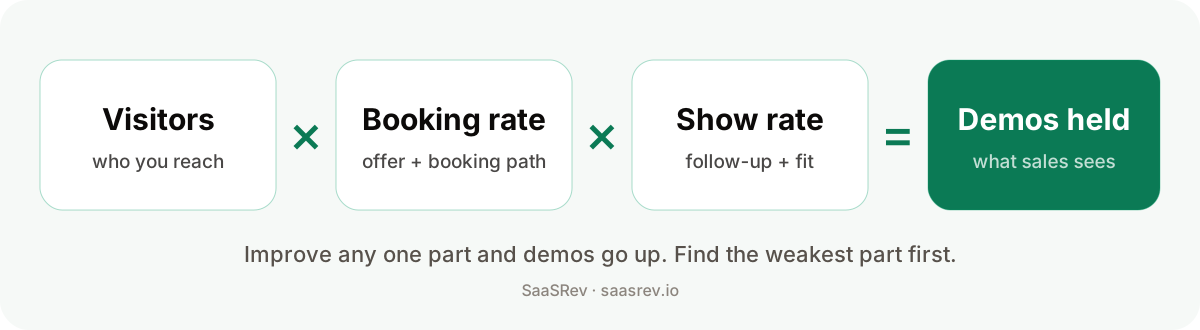
Improve any one of the three and demos go up. Most teams only work on the first, because traffic is the easiest thing to buy. It is also the most expensive to get wrong. Check the other two before you raise your budget.
| What you see | Where the leak probably is | Start with |
|---|---|---|
| Plenty of visits, few booked calls | Booking rate: the offer or the booking path | Fix 2 and Fix 5 |
| Calls get booked, but people do not show up | Show rate: follow-up and expectations | Fix 4 |
| Calls happen, but they are poor fits | Targeting and qualification | Fix 1 and Fix 3 |
| Few visits from the right companies | Visitors: who you reach | Fix 1 |
| Demos happen, but you cannot say which ads caused them | Tracking | Fix 6 |
Find your three numbers, find the weakest one, fix that for a few weeks, then measure again.
Fix 1: Are you reaching buyers who are already in market?
Aim your spend at companies that are researching tools like yours right now, not at everyone who matches a job-title list. A buyer who is already comparing options books a demo for a different reason than a buyer who has never thought about the problem.
Intent data is one way to find those accounts: it shows which companies are researching your category. At SaaSRev we target accounts already researching tools like yours, test new creative angles every 3 to 5 days, cut what lags and put the budget behind what wins. Treat intent data as a signal, not a promise, and test it against a plain targeting campaign so you know it earns its cost. See how intent data ads work, or read about our SaaS PPC service.
Fix 2: Is your offer clear enough for cold traffic?
A cold visitor does not know you, so they need to see in a few seconds what you do, who it is for and what they get from a call. If they have to work that out, most will leave.
Build the offer from the exact words your buyers use. Listen to your sales calls, collect the objections, and copy the phrases customers use when they are ready to buy. That is why SaaSRev starts every engagement with a 14-day audit of sales calls, messaging and ideal customer profile before any ads run. Keep the page to one audience, one problem, one outcome and one next step.
Fix 3: Should you qualify buyers before the call?
Yes, if your sales time is limited. A short video and a few qualifying questions before the booking filter out poor fits and prepare the good ones, so your team spends its calls on people who can buy.
This is how a VSL funnel works for SaaS: the buyer watches the video, answers the qualifying questions, books a call, and arrives already knowing what they want. The trade-off is honest: you will see fewer raw bookings. Judge the change by qualified demos and pipeline, not by the number of calendar entries. Read more about how our VSL funnels work.
Fix 4: How fast should you follow up?
As fast as you can, in minutes, not days. A booking is warmest right after it happens, and a buyer who has heard nothing for a day has already started to cool.
Send an immediate confirmation that says what will happen on the call and what to bring, then reminders by email and, only for people who agreed to it, by text message. Give people a reason to show up. Our own confirmation page plays a short welcome video and shows client case studies, so a booked buyer is reminded why the call is worth their time.
Fix 5: Is your booking path short enough?
Every extra step and every extra form field costs you bookings. Put the calendar on the page, ask only for what you need to route the call (name, work email and company), and remove everything else. You can ask more questions on the call.
Our booking page puts the promise first, the calendar right below it, and proof after that. Change one thing at a time, so you know which change moved the number.
Fix 6: Are you tracking demos, or only clicks?
Track every demo from the first click to closed revenue. If you only track clicks and form fills, you will end up optimizing for cheap bookings that never close.
The numbers worth watching are cost per qualified demo, lead-to-demo rate, customer acquisition cost (CAC), and the pipeline and revenue each channel produces. Then cut what lags and scale what works. To plan backwards, divide the deals you want by your close rate to get the demos you need, and try the ARR calculator to see what that is worth. If CAC is the number that hurts, read how to lower SaaS CAC when paid ads get expensive.
What does this look like in practice?
SaaSRev has published results from clients who fixed this path. Instapatient had product-market fit but only two demos a week with no predictable rhythm, and went to 100 demos a month after SaaSRev built its acquisition engine. KBS Media went from $0 to $30K MRR in 30 days. You can read more in our case studies.
These are results from specific engagements. They depend on each company's product, market, budget and sales process, and they are not a guarantee. See our Terms of Use for details.
If you want help finding which of the six fixes your funnel needs first, book a strategy call.
Frequently asked questions
How many demos should a B2B SaaS book each week?
It depends on your contract value and close rate. Work backwards: divide the deals you want each month by your demo-to-close rate to get the demos you need. SaaSRev's best-fit clients aim for 3 to 5 pre-qualified demos a week, but your own number should come from your own math.
Should I run ads or outbound to get more demos?
Both can work, and they fail in different ways. Ads depend on budget and how well you reach people who are interested. Outbound depends on list quality and email deliverability. Start with the channel where your buyers already show intent, get that path booking calls, then add the other.
How long does it take to see more demos?
Changes you control directly, such as the booking path and follow-up, can show up within a few weeks. Targeting and creative tests take longer because ad platforms need data. SaaSRev tests new creative angles every 3 to 5 days so learning does not stall.
What is the difference between a demo request and a qualified demo?
A demo request is anyone who books. A qualified demo is someone who fits your ideal customer profile and is ready to talk about buying. Count qualified demos, because only those turn into pipeline.