
Instapatient already had what many early-stage SaaS companies spend years looking for: strong unit economics, customers who stayed, and real retention. Almost nobody was seeing the product, though. The company was getting about two demos a week.
What was the problem?
Instapatient was not losing on product or on price. It was losing on volume. Too few qualified buyers reached the pipeline each week.
The pipeline had no rhythm. Some weeks brought a handful of conversations and others brought none, so the team could not forecast or plan around it.
The math made the gap clear. With an average customer lifetime value above $10,000 and a payback period that should have been under two months, every missed demo was a possible customer worth five figures.
What did SaaSRev change?
We rebuilt the acquisition system around one number: demos booked with qualified buyers. Not leads, traffic or form fills.
- Outbound and paid acquisition, working together. Outbound went directly after the right buyers. Paid acquisition created steady inbound demand and kept the pipeline full between outbound cycles.
- Tighter qualification. Every lead was checked against Instapatient's ideal customer profile before it could reach the calendar, so more demos meant more of the right demos.
- Faster speed to revenue. Follow-up got quicker, triage got tighter, and the time between first touch and booked demo got shorter. Every day a qualified lead sat uncontacted added to the payback period.
What were the results?
| Before | After | |
|---|---|---|
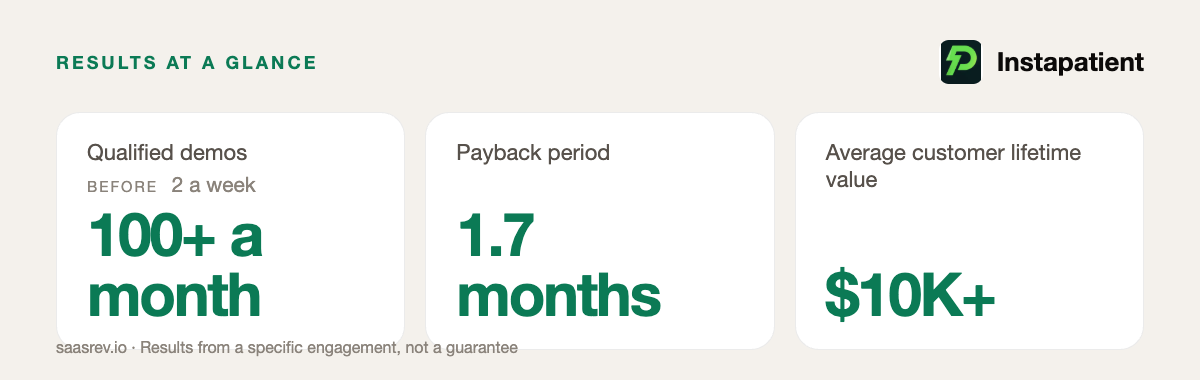
| Qualified demos | About 2 a week | Over 100 a month |
| Payback period | Not reported | 1.7 months |
| Average customer lifetime value | Above $10,000 | Stayed above $10,000 |
| Pipeline | Inconsistent, hard to forecast | Steady, forecastable |
Demo volume rose roughly 12 to 13 times. The unit economics that had always been strong on paper now showed up in practice, and the team could plan from its pipeline instead of hoping for a good week.
What does this case show?
Volume without qualification hurts unit economics, and qualification without volume keeps a good product invisible. Instapatient needed both at the same time, aimed at the same outcome.
If your pipeline has the same shape, read how to get more demos for your B2B SaaS, or see how our SaaS PPC service works.
Common questions
How many demos did Instapatient get?
Instapatient went from about 2 demos a week to over 100 qualified demos a month.
What did SaaSRev change for Instapatient?
SaaSRev rebuilt the acquisition system around booked demos, with outbound and paid acquisition working together and tighter qualification.
What were Instapatient's unit economics?
Payback period was 1.7 months and average customer lifetime value was above $10K.
This is the result of a specific engagement. It depends on the company's product, market, budget and sales process, and it is not a guarantee. See our Terms of Use for details.