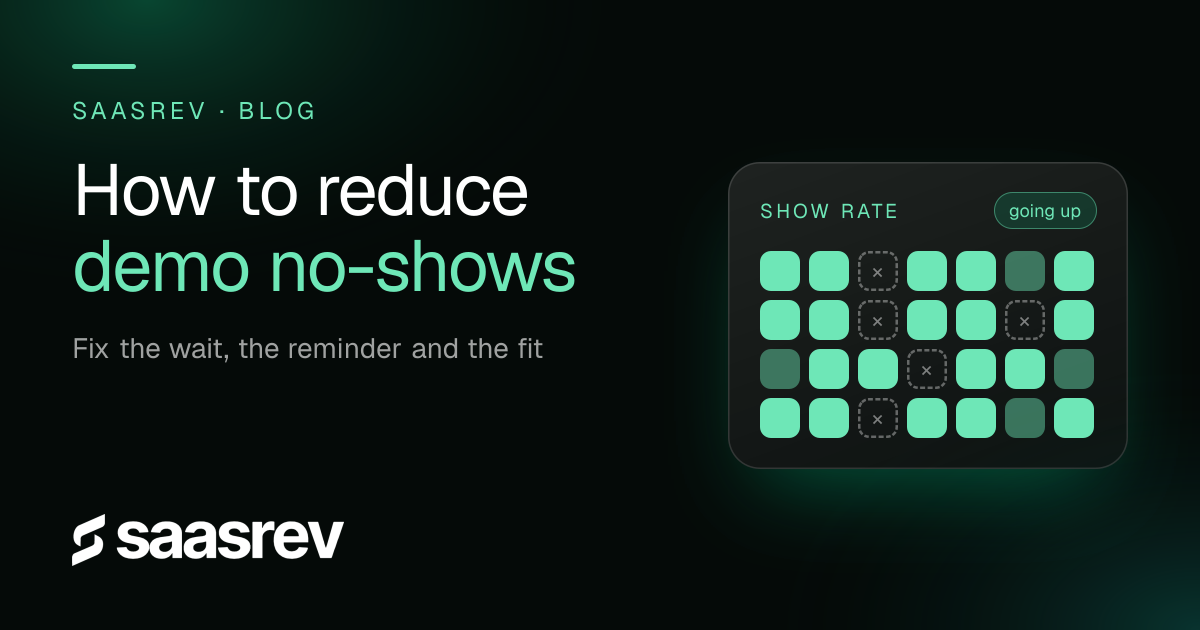
To reduce demo no-shows, shorten the wait between booking and the call, make the confirmation say exactly what will happen, send reminders that give a reason to attend, and qualify people before they can book. Most no-shows come from weak intent or a forgotten call, and each cause has its own fix. Below is how to tell which one you have, and what to change first.
How common are demo no-shows, and what do they cost?
Vendor-published estimates put typical demo no-show rates between 20% and 40%. Treat that as a range to compare against, not a target, because the real number depends on your deal size and how the person ended up on your calendar.
The cost is easy to work out. A no-show is a demo you paid to generate and did not get, so it raises your cost per held demo and your CAC directly. Take the made-up example from our CAC post: lifting show rate from 70% to 80% on its own cuts CAC by about 12.5%, from roughly $2,286 to $2,000, with no change in what each booking cost. Show rate is one of the cheaper numbers in a funnel to improve.
Why do booked demos go unattended, and where do you start to reduce demo no-shows?
People skip a call for a small set of reasons. Find the row that matches what you see.
| What you see | Likely cause | Start with |
|---|---|---|
| Calls booked more than a week out go unattended | The wait is too long and the urgency fades | Fix 1 |
| Buyers say they did not know what the call was | The confirmation was vague | Fix 2 |
| Buyers say they forgot or got the time wrong | Reminders are missing or unclear | Fix 3 |
| Calls that do happen are poor fits | Weak intent at the booking step | Fix 4 |
| Show rate varies a lot between campaigns | Some ads attract low-intent bookers | Fix 5 |
Fix 1: How long should buyers wait for the call?
As short as your calendar allows. Several sources report that no-show rates rise once a meeting is more than about a week out, which matches common sense: the interest that made someone book fades each day.
Offer slots in the next few days first. If your calendar shows the first opening two weeks away, change that before you touch anything else. When you cannot offer a quick slot, make the longer wait feel intentional by sending something useful in the meantime, such as a short video or a one-page agenda.
Fix 2: What should the confirmation say?
It should say what will happen on the call, who the buyer will speak to, how long it takes, what to bring and how to reschedule. A booking confirmation that only says "You are scheduled" leaves the buyer guessing, and a guessing buyer is easier to lose.
Some no-shows come from simple confusion, such as buyers who were not sure whether they booked a live conversation or a recorded demo, or who misread the time zone. Put the time in the buyer's own time zone, and say plainly that it is a live call with a person. Our own confirmation page plays a short welcome video and shows client case studies, so a booked buyer is reminded why the call is worth their time.
Fix 3: How many reminders should you send?
Send one right after booking, one the day before and one an hour or so before the call. Each one should carry the time, the way to join and a reschedule link, and the day-before message can add a line about what you will cover.
Send text reminders only to people who agreed to texts when they booked. Keep reminders short, and do not send so many that they feel like pressure. A reminder with a one-click reschedule link gives a busy buyer a way out that is better for both sides than silence.
Fix 4: Can you qualify buyers before the calendar opens?
Yes, and it can move show rate more than one more reminder will. When anyone can book in two clicks, some people book on impulse or to get a quick answer, and they have little reason to attend.
A short video and a few questions before the booking step ask for a little effort first, so the people who reach the calendar have chosen to be there. You will see fewer raw bookings, and a higher share of them will turn up. Judge the change by qualified demos held, not by calendar entries. We explain the mechanics in what a VSL funnel is, and you can see the service on our VSL funnels for SaaS page.
Fix 5: Do some campaigns produce more no-shows than others?
They can, and it is easy to miss if you only watch one overall number. Track show rate by campaign and ad angle, not just overall. An ad that promises a free audit might fill the calendar with people who want the audit and not the conversation, while a more specific ad brings in fewer people who attend.
If one campaign has a clearly lower show rate, look at what that ad promised and who it targeted. The fix is usually in the ad or the page it leads to, not in the reminders. This is also why we track every demo back to the campaign behind it. For more on the path from click to call, read how to get more demos for your B2B SaaS.
What have clients achieved?
SaaSRev has published results from clients who fixed the path from ad to call. KBS Media went from $0 to $30K MRR in 30 days, and YourAtlas went from $10K to $100K+ MRR in 120 days. You can read more in our case studies.
Those results come from specific engagements and are not about show rate alone. They depend on each company's product, market, budget and sales process, and they are not a guarantee. See our Terms of Use for details.
If you want help finding where your demos are leaking, book a strategy call.
Frequently asked questions
What is a normal demo no-show rate?
Vendor-published estimates usually fall between 20% and 40%, but these are loose ranges and not a standard. Your own rate depends on deal size, how far ahead the call is booked and how the lead arrived. Measure your own rate by source first, then try to improve it.
Should I follow up right away after a no-show?
Yes, the same day. Send a short, friendly message that offers one easy way to rebook, and make it clear the call is still worth having. If they miss a second time, stop chasing and move on.
Do text message reminders help?
They can, because people read texts quickly. Send them only to people who agreed to receive texts when they booked, and keep each one short, with the time and a reschedule link.
Is it a problem if a buyer reschedules instead of showing up?
No, a rescheduled call is far better than a no-show. Make rescheduling a single click in every reminder, so that someone who cannot attend has an easy option that is not silence.