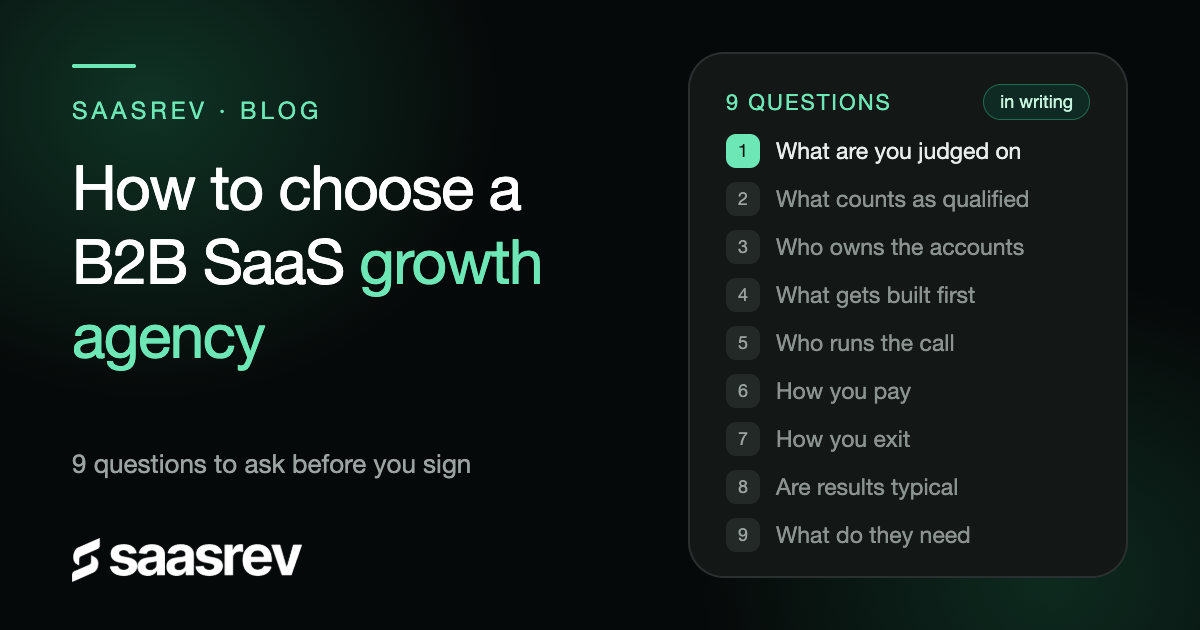
Choose a B2B SaaS growth agency by what it is willing to put in writing. Ask what it is judged on, how it defines a qualified demo, who owns the accounts and data, what it builds before ads launch, who runs the sales call, how it charges, how long you are locked in, whether its results are typical, and what it needs from you. The nine questions below each come with what a good answer sounds like and what a weak one sounds like.
We are a SaaS growth agency ourselves, so we say where our own answers stand. Judge them by the same questions.
1. What are you judged on?
A good answer names a business result: qualified demos, pipeline or closed revenue. A weak answer names activity: clicks, leads, impressions or "engagement".
The reason is that activity can rise while revenue stays flat. A campaign that doubles leads but fills the calendar with the wrong buyers has looked successful on a report and failed in the business. Ask which number the agency will be reviewed against each month, and whether it will trace that number from the first click through to closed revenue.
Our own answer: we are judged on qualified demos and closed ARR, and every demo is tracked from the first click to the closed deal.
2. How do you define a "qualified" demo, in writing?
A good answer is a short written definition that you both agree on, such as company size, role, problem and timeline. A weak answer is "we only send good leads".
"Marketing qualified" and "sales qualified" are used differently from one company to the next, so the same word can mean very different things. This matters most when pay is tied to the count. If an agency is paid per qualified lead and the definition is loose, the count can grow without the quality. Ask who decides whether a demo qualifies, and what happens when your team disagrees.
3. Who owns the ad accounts, the data and the creative?
A good answer is that you own them, or that you receive them in full if you leave. A weak answer is vague, or the agency keeps them.
Ad accounts, tracking setup, audiences, landing pages and creative are the assets that make a campaign work. If you cannot take them with you, leaving means starting again from zero. Get ownership and access written into the agreement before you sign, not when you want to leave.
4. What do you build before the ads launch?
A good answer includes the offer, the messaging and the funnel, because ads alone cannot fix them. A weak answer is "we launch ads in week one".
If the offer is unclear or the page does not convince a cold visitor, more traffic only makes the problem more expensive. We covered this in how to lower SaaS CAC when paid ads get expensive and in how to get more demos for your B2B SaaS. Ask what happens in the first two weeks, and whether the agency audits your offer and your sales calls before it spends your budget.
Our own answer: we start with a 14-day offer audit, then build the messaging, the VSL funnel and the follow-up.
5. Who runs the sales call, and who follows up with leads?
A good answer is specific about who does what. A weak answer says "we handle everything" without saying who talks to the buyer.
Models differ. Some agencies place their own SDRs on every lead. Rapid Product Growth, for example, says its in-house SDRs contact each lead within five minutes. Others, like us, build the system that books the demo and leave the call to your team. Neither is wrong, but they suit different companies. If you have no one to follow up quickly, you need that covered. If you already have reps, you may not want to pay for a second team. See how this plays out in our comparison with Rapid Product Growth.
6. How do you charge, and what is not included?
A good answer explains the model and lists the exclusions. A weak answer gives a single number with no breakdown.
We read the public sites of nine companies on 2026-11-09 and saw three different models. Kalungi describes a retainer-based model that may include a performance component. Rapid Product Growth describes a fee plus a separate ad budget. Lustra Labs describes a setup fee and a price per qualified lead once a minimum is met. Most did not publish prices at all.
Ask whether ad spend goes to the ad platforms directly or through the agency, what happens to unspent budget, and what extra costs exist for creative, tools or extra hires. Ours: ad spend goes straight to the ad platforms, and fees depend on your stage and how much of the funnel we build.
7. How long is the contract, and how do I leave?
A good answer is a clear minimum term, a notice period and a handover plan. A weak answer is a long lock-in with no exit if results do not appear.
Some programs ask for time. Kalungi's FAQ suggests allowing six to twelve months to see impact, because it runs a whole marketing function. That can be reasonable for a department. For a focused system such as paid ads and a funnel, ask for earlier checkpoints: tracking working, ads live, first qualified demos. Ask what you get back if you leave, which ties to question 3.
8. Are your case studies typical?
A good answer comes with context: who the client is, what they started with, how many clients look like this, and what a typical result is. A weak answer shows only the best case.
A regulator asks the same thing. The US Federal Trade Commission's Endorsement Guides say that if an ad features one customer's experience with a key result, people will likely read it as what customers generally achieve. The advertiser should then either have evidence that it is representative or clearly say what results to generally expect (16 CFR 255.2(b)). The guides are written for consumer advertising, but the question is the right one to ask any agency: is this result normal, or the best one you have?
Ask for named references you can call, the number of clients in the same range, and one example that did not go well and why. Our case studies are results from specific engagements. They depend on the company's product, market, budget and sales process, and they are not a guarantee. You can read them in our case studies.
9. What do you need from us, and when are you not a fit?
A good answer includes a clear fit: stage, budget, team and the things the agency cannot do. A weak answer is "we work with everyone".
An agency that cannot say who it is not for is guessing about who it can help. Ours is public: SaaSRev fits B2B SaaS companies that already have paying customers, can put $3K to $5K a month into ads and want 3 to 5 pre-qualified demos a week. It is not a fit for pre-revenue companies or teams still searching for product-market fit. Ask for the same from any agency you talk to.
What are the different types of agency you will meet?
The nine questions matter more once you know which kind of provider you are talking to. In the nine we compared, we saw paid media agencies, a funnel-and-ads agency, an outsourced marketing department, a staffing and media-buying firm, coaching and advisory programs, and a build studio with a growth arm. They solve different problems.
- A media buyer runs ads across channels. See SaaSRev vs Hey Digital.
- A paid-ads-first growth agency builds the funnel as well. See SaaSRev vs Growable.
- An outsourced marketing department covers brand, content and demand generation. See SaaSRev vs Kalungi.
- A staffing or coaching model adds people or teaches yours. See SaaSRev vs Darwinian Ventures and SaaSRev vs SaaS Academy.
All the comparisons are listed on our compare page.
What should you do before you choose a B2B SaaS growth agency?
Write down three things so the conversation is about your situation, not a pitch: your current demo-to-close rate, what a customer is worth, and how much you can spend on ads each month. Then ask every agency the same nine questions and put the answers side by side. If one will not answer in writing, that is an answer.
If you want us to look at your funnel against these questions, book a strategy call from our SaaS PPC agency page. Qualified companies get a free audit that points out the fastest wins.
Sources
- US Federal Trade Commission, Guides Concerning the Use of Endorsements and Testimonials in Advertising, 16 CFR 255.2 (ecfr.gov/current/title-16/chapter-I/subchapter-B/part-255/section-255.2), read 2026-11-09
- Kalungi, FAQ (kalungi.com/faq), read 2026-11-09
- Rapid Product Growth, website (rapidproductgrowth.com), read 2026-11-09
- Lustra Labs, website (lustralabs.com), read 2026-11-09
- Darwinian, website (darwinian.com), read 2026-11-09
- Hey Digital, Growable, SaaS Academy and Directive Consulting, public websites, read 2026-11-09 (see the linked comparison pages for details)
Frequently asked questions
How much does a B2B SaaS growth agency cost?
It varies too much to give one number. In the public sites we read on 2026-11-09, most agencies did not publish prices. The models we saw were a monthly retainer, a fee plus a separate ad budget, and a setup fee plus a price per qualified lead. Ask for the model first, then the price, and ask what is not included.
Should a SaaS company hire an agency or an in-house marketer?
It depends on whether you need a person or a result. An in-house hire gives you ongoing ownership and context. An agency gives you a team with a tested process faster. If the gap is one specific thing, such as booked demos from paid ads, a focused agency is usually quicker to start than a hire.
What are red flags when hiring a growth agency?
Promises of a specific result with no conditions, success measured in clicks or leads rather than qualified demos, refusing to define a qualified demo in writing, owning your ad accounts or data, long minimum terms with no exit, and case studies with no named clients or no context.
Does the agency need to specialize in SaaS?
It helps, because SaaS has its own metrics, such as CAC payback, ARR and demo-to-close rate, and its own sales cycle. Ask for examples of SaaS companies at your stage, not only a list of industries served.