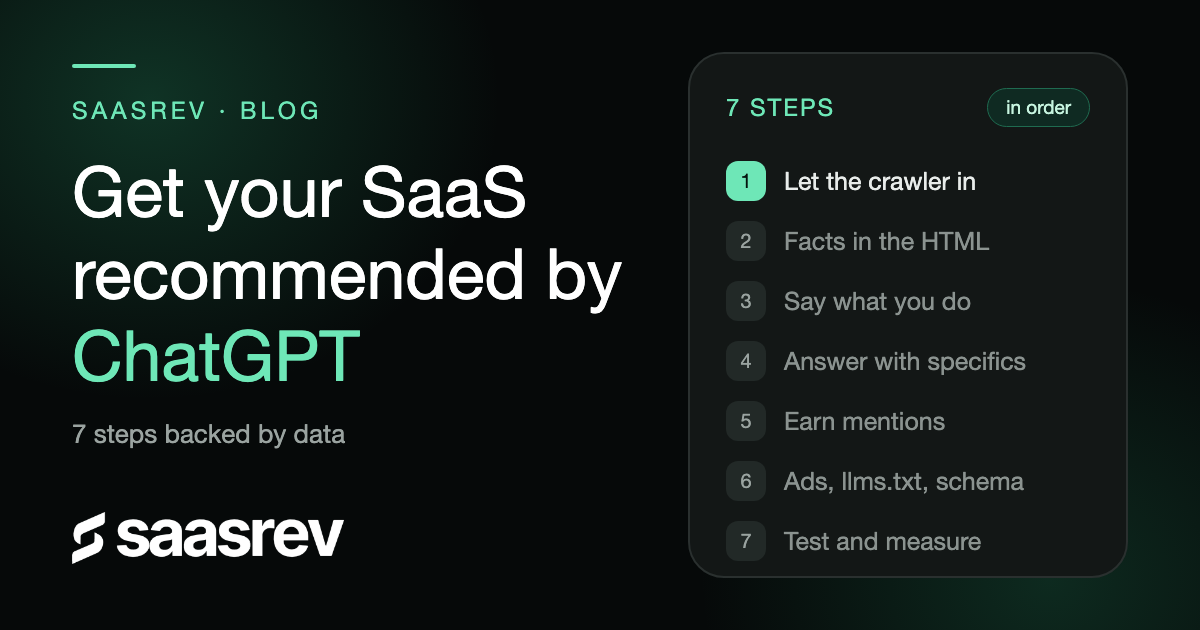
You get recommended by ChatGPT by making your SaaS easy to read, easy to describe, and widely mentioned. That means letting OpenAI's search crawler in, putting plain facts in your pages, answering buyer questions with specifics, and getting named by independent sources. Nobody can pay for or guarantee a recommendation, and OpenAI does not publish how it chooses. So this guide separates what OpenAI documents, what studies have measured, and what is still a guess.
How does ChatGPT decide which SaaS to recommend?
OpenAI has not published a ranking formula, so no one outside OpenAI knows exactly. What we can use falls into three groups, and it helps to keep them apart.
| Kind of evidence | What it tells us | How far to trust it |
|---|---|---|
| OpenAI's own documentation | Which crawlers exist, what each is for, and what blocking each one does | Highest. It is the source. |
| Studies of AI answers | Which things go together with brands being mentioned | Medium. They show correlation, not cause. Most come from companies that sell AI-visibility tools. |
| Advice articles and opinion | Guesses about how it works | Low, unless they point to data |
This guide uses the first two and says when something is only our reasoning. If a post tells you "ChatGPT ranks by X" without a source, ask where the number comes from.
Step 1: Are you letting OpenAI's search crawler in?
Check this first, because nothing else matters if ChatGPT's search crawler cannot read your site. OpenAI runs three crawlers with three different jobs, and its documentation says each setting is independent of the others.
| Crawler | What OpenAI says it is for | Does robots.txt control it? |
|---|---|---|
| OAI-SearchBot | Surfacing websites in ChatGPT's search features | Yes |
| GPTBot | Making OpenAI's generative AI foundation models more useful and safe (training) | Yes |
| ChatGPT-User | Certain actions a user starts inside ChatGPT and Custom GPTs | Not necessarily. OpenAI says robots.txt rules may not apply, and it is not used to decide what appears in search. |
Two details matter in practice. First, OpenAI states that sites opted out of OAI-SearchBot will not be shown in ChatGPT search answers, though they can still appear as navigational links. Second, it says a robots.txt change can take about 24 hours to take effect for search.
So a block on OAI-SearchBot is the one that removes you from ChatGPT's search answers. Blocking GPTBot only opts you out of training. Some SaaS teams block both on purpose. Others block them by accident through a security plugin, a firewall rule or a copied robots.txt file, and never notice.
A simple robots.txt that lets all three in looks like this:
User-agent: OAI-SearchBot
Allow: /

User-agent: GPTBot
Allow: /

User-agent: ChatGPT-User
Allow: /
To check for an accidental block, open yourdomain.com/robots.txt and look for any rule that mentions these names or blocks everything. Then test a real request with curl -I -A "OAI-SearchBot" https://yourdomain.com/. A normal 200 response means you are not blocking that name. Some firewalls identify bots by IP address instead of name, so also look at your server logs for real visits. That last part is our reasoning, not something OpenAI documents.
Our own robots.txt at saasrev.io/robots.txt names these bots and allows them, along with the crawlers from Anthropic, Perplexity, Google and Apple.
Step 2: Is your content in the HTML, not built by JavaScript?
Put the facts you want quoted in the page's HTML, because AI crawlers may not run your JavaScript. In December 2024, Vercel and MERJ analysed crawler traffic across Vercel's network and found that none of the major AI crawlers rendered JavaScript, including OpenAI's three. They fetched JavaScript files, but did not run them. Google's Gemini was the exception, because it uses Google's own crawling infrastructure.
That study is almost a year old, and crawlers change, so check your own site rather than trusting the date. Run curl -s https://yourdomain.com/your-page | grep "your main claim". If your headline, price, feature list or customer proof is missing from that output, a crawler that does not run JavaScript sees an empty page.
For a B2B SaaS, the usual offenders are:
- Pricing or plan tables that load after the page opens
- Feature lists inside tabs or sliders built on the client
- Customer results shown only in an image or a video
- Pages that show a loading spinner first
Server-render or pre-build any page you want to be quoted. This site's pages are built ahead of time, so the text is in the first response.
Step 3: Does your own site say, in plain words, what you do and who it is for?
State your category, your customer and your main use case in one clear sentence, on your homepage and in your product pages. Your own site matters more than many teams expect. Profound analysed 11.84 billion AI citations from 16 April to 16 July 2026 and reported that ChatGPT cites company-owned sites for 47% of its citations. That is the lowest share among the major answer engines it studied, but it is still close to half. Profound also reported that SaaS and software companies get a median of only 11.4% of their citations from earned media, such as press and review coverage, across all platforms. That is far lower than the 59% median Profound reported for pharma and biotech, so for software the company's own pages carry more of the weight.
Profound sells AI-visibility tooling and publishes only observational data, so treat these as a guide. They still point the same way as common sense: if the model or the search step reads your site, it should find a clear answer.
What to write:
- One sentence on the homepage in the form "[Product] is a [category] for [customer] that helps them [outcome]."
- The same sentence, word for word, in your directory profiles, your social bios and your press mentions. Our reason for this is simple: a model learns what you are from repeated, matching descriptions, and mixed descriptions give it nothing consistent to repeat. This is reasoning, not a documented rule.
- A real pricing page, or a clear statement of how pricing works. Buyers ask "how much does it cost" in AI tools, and a missing answer gets filled by someone else's page.
- Pages for each audience you serve, so the model can match you to the right question.
Step 4: Do your pages answer buyer questions with specifics?
Write each page so the first sentence under a question heading answers the question, then add numbers, sources and quotes. The strongest published test of this is the "GEO" paper from researchers at IIT Delhi and Princeton, accepted at KDD 2024. They built a benchmark of 10,000 queries and tested nine ways of rewriting a page to see which got it quoted more in a generative engine's answer.
The abstract reports that these methods can raise visibility by up to 40%. In the paper's tests, adding statistics and adding quotations from credible sources performed well, while keyword stuffing, the old SEO habit, did not perform well. The paper also found that lower-ranked sites benefited more than top-ranked ones.
Be careful with how far this goes. The main experiments used a simulated engine built on GPT-3.5-turbo that reads the top five Google results, plus Perplexity. The paper did not test the ChatGPT product itself. Read it as evidence that specifics help a model quote a page, not as a ChatGPT ranking rule.
Google's own documentation points the same way for its AI features. It says there are no additional requirements to appear in AI Overviews or AI Mode, and no special optimizations are needed beyond good SEO. That is Google's statement about Google, not OpenAI, but it suggests that the basics of useful, crawlable pages carry most of the work.
A practical test for each page: could someone copy one paragraph and have it make sense with no other context? If it says "as mentioned above" or "this feature" without naming the product, rewrite it so the paragraph stands alone. For examples of the format, see our guide on how to get more demos for your B2B SaaS.
Step 5: Are enough independent sources talking about you?
Get your brand mentioned in many places you do not control. This is the step with the most data behind it, and the one that takes longest. Ahrefs has run three studies of this, and they agree on the direction.
| Ahrefs study | What it studied | Strongest finding |
|---|---|---|
| May 2025 | 75,000 brands and Google AI Overviews | Branded web mentions correlated at 0.664, against 0.218 for backlinks |
| December 2025 | The same brands across ChatGPT, AI Mode and AI Overviews | YouTube mentions were the strongest factor at about 0.74 |
| November 2026 | 10,000 US brands and 260 million prompts that did not name the brand | Reddit mentions led at about 0.75. Webpage mentions were about 0.70, news about 0.67, YouTube about 0.64 |
In the first study, brands in the top quarter for web mentions averaged 169 AI Overview mentions. Brands in the next quarter down averaged 14, and the bottom two quarters averaged 0 to 3.
Four cautions before you act on this:
- It is correlation. Ahrefs says so itself: "correlation ≠ causation." Big, well-known brands get both more mentions and more AI mentions, and the studies cannot fully separate the two. Ahrefs checked this by comparing brands of similar size, and in every size band the brands with more webpage mentions still tended to earn more AI mentions.
- ChatGPT behaves differently. The November study says ChatGPT is the least tied to off-site mentions across 6 of 7 factors. It also found that 46% of brands had zero mentions in ChatGPT on its own, against 23% in AI Mode and 18% in AI Overviews.
- Returns shrink. Ahrefs reports that 10 times more webpage mentions went with only about 3.7 times more AI mentions, and says a handful of new mentions is unlikely to change anything. It points to a large, sustained increase.
- Do not chase the number. Fake reviews and spam in forums are easy to spot and can hurt your brand with real buyers. Ahrefs' suggestion is to test Reddit and a wide spread of everyday coverage first.
Where a B2B SaaS can earn real mentions (our suggestions to test, not guarantees):
- Honest answers in threads where buyers ask for tools in your category, with your connection to the product stated
- Review and directory profiles that match your homepage wording
- Integration and partner marketplace listings
- Customer case studies that customers also publish or share
- Podcasts, webinars and videos where your team explains something useful
- Original data from your own customers or campaigns, which others can cite
Step 6: What do you do about ads, llms.txt and schema?
Do them after the steps above, and do not expect them to be the deciding factor. Here is what we know about each.
Ads. The December 2025 Ahrefs study found that ChatGPT mentions lined up with brands that had strong advertising presence. The authors added that this does not mean ChatGPT directly rewards ad spend. Their reading is that brands that advertise heavily tend to dominate the kind of content ChatGPT draws on. OpenAI's documentation also lists a crawler, OAI-AdsBot, that checks the safety of pages submitted as ads on ChatGPT. It does not describe any link between ads and the answers.
llms.txt. It is a plain-text map of your site for AI tools. We publish one at saasrev.io/llms.txt because it takes little effort. We have no evidence it changes ChatGPT's answers, and OpenAI's crawler documentation does not mention it as a way to appear in search.
Structured data. FAQ and organization markup states facts in a machine-readable way, and we add it to our posts. We do not have a study that shows it makes ChatGPT recommend a brand, so treat it as good housekeeping.
Step 7: How do you test whether ChatGPT recommends you?
Build a list of 15 questions your buyers actually ask, run them in ChatGPT, and record what comes back. This is the only direct measurement of what you are trying to improve, and it is simple to do.
Use three kinds of question:
| Type | Example for a made-up product called Acme |
|---|---|
| Category | "What are the best onboarding tools for B2B SaaS?" |
| Comparison | "Acme vs a competitor: which is better for a 20-person team?" |
| Direct | "What does Acme cost?" or "Is Acme good for enterprise?" |
Ask each question more than once, because answers can differ between runs. For each one, write down:
- Whether you were named
- How you were described, and whether it was accurate
- Which competitors were named
- Which sources it linked to, if any
Repeat monthly and keep the log. Also look for chatgpt.com in your analytics as a traffic source. If you have no GA4 or similar yet, set that up first, so you can see whether visits from AI tools turn into demos.
What does not work
A few things come up often in advice about this, and the evidence is weak or negative:
- Keyword stuffing. The GEO paper found it did not perform well.
- Hidden text or instructions aimed at AI tools. We have no data that it works, and it risks your credibility with the buyers and search engines who read the page.
- Buying mentions or reviews in bulk. Ahrefs' own caution is that you cannot say mentions cause visibility, so there is no proof that fake ones would help, and they carry real risk.
- Promises of a guaranteed placement. OpenAI's documentation describes no such option.
What should a B2B SaaS do first?
In this order: fix crawl access (an hour), check that key pages work without JavaScript (an afternoon), rewrite your homepage and category pages with one clear description and real numbers (a week), and start the 15-question test so you have a baseline. Then spend the long part of the effort on earning mentions in the places your buyers already look.
We built this site the same way, and it is the same work behind our own SaaS PPC and intent data pages: clear pages, plain facts, a real answer in the first sentence. If you want help working out which of these steps your SaaS needs first, book a strategy call.
Sources
- OpenAI, Overview of OpenAI Crawlers (developers.openai.com/api/docs/bots)
- Ahrefs, An Analysis of AI Overview Brand Visibility Factors, 26 May 2025
- Ahrefs, Top Brand Visibility Factors in ChatGPT, AI Mode, and AI Overviews, 12 December 2025
- Ahrefs, Which Types of Mentions Correlate the Strongest With AI Visibility, 3 November 2026
- Profound, Where do AI citations come from?, 30 July 2026
- Aggarwal et al., GEO: Generative Engine Optimization, KDD 2024 (arxiv.org/abs/2311.09735)
- Vercel and MERJ, The rise of the AI crawler, 17 December 2024
- Google Search Central, AI features and your website
Frequently asked questions
Can you pay to be recommended by ChatGPT?
Not for the answer itself. OpenAI does not sell a recommendation inside ChatGPT's answers, and its documentation describes no way to buy or guarantee a mention in search results. Ads in ChatGPT are a separate product, and what OpenAI documents about them is limited to a crawler that checks the safety of pages submitted as ads.
Does blocking GPTBot keep my site out of ChatGPT search?
No. OpenAI says its crawler settings are independent. GPTBot is about training OpenAI's foundation models, and OAI-SearchBot is the one that decides whether your site can appear in ChatGPT's search answers. You can allow one and block the other.
How long does it take to show up in ChatGPT?
OpenAI says it can take about 24 hours for a robots.txt change to take effect for search results. Being recommended is slower, because it also depends on how widely your brand is described across the web. Expect months of steady work, not days, and treat any promise of a fast result with suspicion.
Do I need an llms.txt file?
It is cheap to add, but we have no evidence that it changes what ChatGPT says. OpenAI's own crawler documentation does not mention llms.txt as a way to appear in search. Do the crawl access, content and mentions steps first.
How do I check if ChatGPT recommends my SaaS?
Ask it the questions your buyers ask, such as best tools in your category and comparisons with your competitors. Ask each question several times, because answers can differ from run to run, and write down whether you appear, how you are described and who else is named.